Home Blog Page 86

Class 12 Maths CBSE Sample Papers

0

CBSE Sample Papers For Class 12 Maths 2016-2017

CBSE Sample Papers For Class 12 Maths 2015-2016

[showhide type=”post” more_text=”All Updated soon” less_text=”All Updated soon”]

12 class maths model paper arihant sample papers class 12 maths blueprint of class 12th maths paper cbse class 12 maths board papers 2012 solved cbse class 12 maths board papers free download cbse class 12 maths chapter wise test papers cbse class 12 maths exam paper 2013 cbse class 12 maths exam paper 2015 cbse class 12 maths foreign papers cbse class 12 maths guess paper 2013 cbse class 12 maths guess papers cbse class 12 maths guess papers 2014 cbse class 12 maths guess papers 2015 cbse class 12 maths half yearly sample papers cbse class 12 maths last 5 years question papers cbse class 12 maths paper 2013 download cbse class 12 maths paper 2013 meritnation cbse class 12 maths paper 2013 tough cbse class 12 maths paper 2014 news cbse class 12 maths paper 2014 pdf cbse class 12 maths paper 2014 tough cbse class 12 maths paper 2015 grace marks cbse class 12 maths paper 2015 latest news cbse class 12 maths paper 2015 outside delhi cbse class 12 maths paper 2015 tough cbse class 12 maths paper 2015 with solutions cbse class 12 maths paper answer key 2015 cbse class 12 maths paper decision cbse class 12 maths paper disaster cbse class 12 maths paper download cbse class 12 maths paper evaluation cbse class 12 maths paper latest news cbse class 12 maths paper leaked cbse class 12 maths paper leaked 2014 cbse class 12 maths paper leaked 2015 cbse class 12 maths paper news cbse class 12 maths paper pattern cbse class 12 maths paper review cbse class 12 maths paper review 2015 cbse class 12 maths paper tough cbse class 12 maths previous year papers with solutions cbse class 12 maths previous year question papers 2011 cbse class 12 maths previous year question papers 2013 cbse class 12 maths previous year question papers download cbse class 12 maths previous year question papers solved cbse class 12 maths previous year question papers with solutions pdf cbse class 12 maths question paper of 2010 cbse class 12 maths question paper of 2013 cbse class 12 maths question paper pattern cbse class 12 maths question paper pattern 2015 cbse class 12 maths question papers download cbse class 12 maths question papers last 10 years cbse class 12 maths question papers with answers cbse class 12 maths sample paper pdf cbse class 12 maths sample papers 2014-15 cbse class 12 maths sample papers 2015 cbse.nic.in cbse class 12 maths sample papers with answers 2014 cbse class 12 maths sample papers with answers 2015 cbse class 12th maths paper leaked cbse class 12th maths paper news cbse class xii maths paper 2015 news cbse class xii maths papers 2013 class 12 maths board paper 2012 with solutions class 12 maths board paper 2013 download class 12 maths board paper 2013 pdf class 12 maths board paper 2013 with solutions class 12 maths board paper 2014 solution class 12 maths board paper 2015 news class 12 maths board paper 2015 pdf class 12 maths board paper 2015 review class 12 maths board paper 2015 solutions class 12 maths board paper of 2014 class 12 maths board papers class 12 maths board papers 2013 class 12 maths board papers 2014 class 12 maths board papers 2015 class 12 maths compartment paper class 12 maths compartment paper 2011 class 12 maths compartment paper 2013 class 12 maths compartment paper 2014 class 12 maths exam paper class 12 maths guess paper class 12 maths guess paper 2014 class 12 maths guess paper 2015 class 12 maths last year papers class 12 maths paper 2013 class 12 maths paper 2013 cbse class 12 maths paper 2014 class 12 maths paper 2015 class 12 maths paper 2015 analysis class 12 maths paper 2015 answer key class 12 maths paper 2015 download class 12 maths paper 2015 news class 12 maths paper 2015 pdf class 12 maths paper 2015 review class 12 maths paper 2015 solution class 12 maths paper 2015 tough class 12 maths paper analysis 2015 class 12 maths paper blueprint class 12 maths paper cbse class 12 maths paper cbse 2014 class 12 maths paper cbse 2015 class 12 maths paper download class 12 maths paper leaked class 12 maths paper leaked 2015 class 12 maths paper news class 12 maths paper news 2015 class 12 maths paper of 2015 class 12 maths paper review class 12 maths paper solution class 12 maths paper solution 2015 class 12 maths paper stumps students class 12 maths paper tough class 12 maths paper was tough class 12 maths papers class 12 maths practice papers class 12 maths previous year question papers class 12 maths question paper 2009 class 12 maths question paper 2011 class 12 maths question paper 2012 class 12 maths question paper 2014 class 12 maths question paper 2015 class 12 maths question paper 2015 pdf class 12 maths question paper cbse class 12 maths question papers class 12 maths question papers 2013 class 12 maths sample paper cbse board 2014 class 12 maths sample paper download class 12 maths sample paper free download class 12 maths sample papers class 12 maths sample papers 2012 class 12 maths sample papers 2015 class 12 maths sample papers of cbse board class 12 maths sample papers of cbse board 2013 class 12 maths sample papers with answers class 12 maths sample papers with answers 2014 class 12 maths solved papers class 12 maths test papers class 12 th maths paper 2015 class 12th maths paper 2015 download class 12th maths paper leaked class 12th maths question paper 2015 class 12th maths sample papers mp board class xii maths paper tough class xii maths question papers class xii maths sample papers 2013 class xii maths sample papers 2015 evergreen sample papers for class 12 maths evergreen sample papers for class 12 maths 2013 evergreen sample papers for class 12 maths 2014 isc class 12 maths paper isc class 12 maths paper 2013 isc class 12 maths sample papers isc class 12 maths sample papers 2014 jac sample papers class 12 maths maths papers for class 12 cbse board 2012 maths question papers for class 12 kerala maths sample papers class 12 hsc maharashtra maths sample papers class 12 maharashtra board maths sample papers for class 12 issued by cbse mycbseguide class 12 maths previous year papers mycbseguide class 12 maths test papers nios class 12 maths paper review of class 12 maths paper rohit sample papers for class 12 maths sample papers for class 12 maths gseb sample papers for class 12 maths hbse sample papers for class 12 maths mp board sample papers for class 12 maths mp board 2014 sample papers for class 12 maths olympiad sample papers for class 12 maths up board solution of class 12 maths paper 2015 ulike sample papers class 12 maths ulike sample papers class 12 maths 2013 ulike sample papers class 12 maths 2015 ulike sample papers for class 12 maths 2012 xam idea class 12 maths sample papers xamidea maths class 12 sample papers 

[/showhide]

CBSE Sample Papers for Class 12 Maths Solved 2016 Set 2

0

SECTION-A

Question numbers 1 to 6 carry 1 mark each.
CBSE Sample Papers for Class 12 Maths Solved 2016 Set 2-1

CBSE Sample Papers for Class 12 Maths Solved 2016 Set 2-2

3.If P(2, 3, 4) is the foot the of the perpendicular from the origin to a plane, then write the vector equation of this plane.

CBSE Sample Papers for Class 12 Maths Solved 2016 Set 2-3

CBSE Sample Papers for Class 12 Maths Solved 2016 Set 2-4

6.Write the differential equation representing the curve y2 = 4ax, where a is an arbitrary constant.

SECTION – B

Question numbers 7 to 19 carry 4 marks each.
7.To raise money for an orphanage, students of three schools A, B and C organized an exhibition in their locality, where they sold paper bags, scrap-books and pastel sheets made by them using recycled paper, at the rate of Rs 20, Rs 15 and Rs 5 per unit respectively. School A sold 25 paper-bags, 12 scrap-books and 34 pastel sheets. School B sold 22 paper-bags, 15 scrapbooks and 28 pastel-sheets while school C sold 26 paper-bags, 18 scrap-books and 36 pastel sheets. Using matrices, find the total amount raised by each school.By such exhibition, which values are inculcated in the students ?

CBSE Sample Papers for Class 12 Maths Solved 2016 Set 2-5

CBSE Sample Papers for Class 12 Maths Solved 2016 Set 2-6

CBSE Sample Papers for Class 12 Maths Solved 2016 Set 2-7

CBSE Sample Papers for Class 12 Maths Solved 2016 Set 2-8

12.Consider the experiment of tossing a coin. If the coin shows tail, toss it again but if it shows head, then throw a die. Find the conditional probability of the event that ‘the die shows a number greater than 3’ given that ‘there is at least one head’.
Or
How many times must a man toss a fair coin so that the probability of having at least one head is more than 90% ?

CBSE Sample Papers for Class 12 Maths Solved 2016 Set 2-9

CBSE Sample Papers for Class 12 Maths Solved 2016 Set 2-10

CBSE Sample Papers for Class 12 Maths Solved 2016 Set 2-11

16.If x = sin t, y = sin kt, show that,
CBSE Sample Papers for Class 12 Maths Solved 2016 Set 2-12

CBSE Sample Papers for Class 12 Maths Solved 2016 Set 2-13

CBSE Sample Papers for Class 12 Maths Solved 2016 Set 2-14

CBSE Sample Papers for Class 12 Maths Solved 2016 Set 2-15

SECTION – C

Question numbers 20 to 26 carry 6 marks each.
CBSE Sample Papers for Class 12 Maths Solved 2016 Set 2-16

21.Compute, using integration, the area bounded by the lines x + 2y = 2, y – x = 1 and 2x + y = 7

CBSE Sample Papers for Class 12 Maths Solved 2016 Set 2-17

CBSE Sample Papers for Class 12 Maths Solved 2016 Set 2-18

24.40% students of a college reside in hostel and the remaining reside outside. At the end of year, 50% of the hostellers got A grade while from outside students, only 30% got A grade in the examination. At the end of the year, a student of the college was chosen at random and was found to get A grade. What is the probability that the selected student was a hosteller ? What value is shown here ?

25.A merchant plans to sell two types of personal computer : a desktop model and a portable model that will cost Rs 25,000 and Rs 40,000 respectively. He estimates that the total monthly demand of computers will not exceed 250 units. Determine the number of units of each type of computers which the merchant should stock to get a maximum profit, if the does not want to invest more than 70 lakh and if his profit on the desktop model is Rs 4,500 and that on portable is Rs 5,000.

26.A jet of enemy is flying along the curve y = x2 + 2 and a soldier is placed at the point (3, 2). Find the minimum distance between the soldier and the jet.

ANSWERS

SECTION-A

Question numbers lto6 carry 1 mark each.
CBSE Sample Papers for Class 12 Maths Solved 2016 Set 2-1
Ans.
CBSE Sample Papers for Class 12 Maths Solved 2016 Set 2-1

CBSE Sample Papers for Class 12 Maths Solved 2016 Set 2-2
Ans. 5 sq.units

3.If P(2, 3, 4) is the foot the of perpendicular from the origin to a plane, then write the vector equation of this plane.
Ans.
CBSE Sample Papers for Class 12 Maths Solved 2016 Set 2-3

CBSE Sample Papers for Class 12 Maths Solved 2016 Set 2-3
Ans.-14

CBSE Sample Papers for Class 12 Maths Solved 2016 Set 2-4
Ans.m+n=4

6.Write the differential equation representing the curve y2 = 4ax, where a is an arbitrary constant.
Ans.
CBSE Sample Papers for Class 12 Maths Solved 2016 Set 2-4

SECTION – B

Question numbers 7 to 19 carry 4 marks each.
7.To raise money for an orphanage, students of three schools A, B and C organized an exhibition in their locality, where they sold paper bags, scrap-books and pastel sheets made by them using recycled paper, at the rate of Rs 20, Rs 15 and Rs 5 per unit respectively. School A sold 25 paper-bags, 12 scrap-books and 34 pastel sheets. School B sold 22 paper-bags, 15 scrapbooks and 28 pastel-sheets while school C sold 26 paper-bags, 18 scrap-books and 36 pastel sheets. Using matrices, find the total amount raised by each school.By such exhibition, which values are inculcated in the students ?
Ans.
CBSE Sample Papers for Class 12 Maths Solved 2016 Set 2-5
Values:i) Helping the Orphans ii)Use of recycled paper

CBSE Sample Papers for Class 12 Maths Solved 2016 Set 2-5
Ans.
CBSE Sample Papers for Class 12 Maths Solved 2016 Set 2-6
CBSE Sample Papers for Class 12 Maths Solved 2016 Set 2-7

CBSE Sample Papers for Class 12 Maths Solved 2016 Set 2-6
Ans.
CBSE Sample Papers for Class 12 Maths Solved 2016 Set 2-8

CBSE Sample Papers for Class 12 Maths Solved 2016 Set 2-7
Ans.
CBSE Sample Papers for Class 12 Maths Solved 2016 Set 2-9

CBSE Sample Papers for Class 12 Maths Solved 2016 Set 2-8
Ans.
CBSE Sample Papers for Class 12 Maths Solved 2016 Set 2-10
CBSE Sample Papers for Class 12 Maths Solved 2016 Set 2-11

12.Consider the experiment of tossing a coin. If the coin shows tail, toss it again but if it shows head, then throw a die. Find the conditional probability of the event that ‘the die shows a number greater than 3’ given that ‘there is at least one head’.
Or
How many times must a man toss a fair coin so that the probability of having at least one head is more than 90% ?

Ans.
CBSE Sample Papers for Class 12 Maths Solved 2016 Set 2-12

CBSE Sample Papers for Class 12 Maths Solved 2016 Set 2-9
Ans.
CBSE Sample Papers for Class 12 Maths Solved 2016 Set 2-13

CBSE Sample Papers for Class 12 Maths Solved 2016 Set 2-10
Ans.
CBSE Sample Papers for Class 12 Maths Solved 2016 Set 2-14
CBSE Sample Papers for Class 12 Maths Solved 2016 Set 2-15

CBSE Sample Papers for Class 12 Maths Solved 2016 Set 2-11
Ans.
CBSE Sample Papers for Class 12 Maths Solved 2016 Set 2-16
CBSE Sample Papers for Class 12 Maths Solved 2016 Set 2-17

16.If x = sin t, y = sin kt, show that,
CBSE Sample Papers for Class 12 Maths Solved 2016 Set 2-12
Ans.
CBSE Sample Papers for Class 12 Maths Solved 2016 Set 2-18

CBSE Sample Papers for Class 12 Maths Solved 2016 Set 2-13
Ans.
CBSE Sample Papers for Class 12 Maths Solved 2016 Set 2-19

CBSE Sample Papers for Class 12 Maths Solved 2016 Set 2-14
Ans.
CBSE Sample Papers for Class 12 Maths Solved 2016 Set 2-20

CBSE Sample Papers for Class 12 Maths Solved 2016 Set 2-15
Ans.
CBSE Sample Papers for Class 12 Maths Solved 2016 Set 2-21

SECTION – C

Question numbers 20 to 26 carry 6 marks each.
CBSE Sample Papers for Class 12 Maths Solved 2016 Set 2-16
Ans.
CBSE Sample Papers for Class 12 Maths Solved 2016 Set 2-22
CBSE Sample Papers for Class 12 Maths Solved 2016 Set 2-23

21.Compute, using integration, the area bounded by the lines x + 2y = 2, y – x = 1 and 2x + y = 7
Ans.
CBSE Sample Papers for Class 12 Maths Solved 2016 Set 2-24
CBSE Sample Papers for Class 12 Maths Solved 2016 Set 2-25

CBSE Sample Papers for Class 12 Maths Solved 2016 Set 2-17
Ans.
CBSE Sample Papers for Class 12 Maths Solved 2016 Set 2-26
CBSE Sample Papers for Class 12 Maths Solved 2016 Set 2-27
CBSE Sample Papers for Class 12 Maths Solved 2016 Set 2-28

CBSE Sample Papers for Class 12 Maths Solved 2016 Set 2-18
Ans.
CBSE Sample Papers for Class 12 Maths Solved 2016 Set 2-29

24.40% students of a college reside in hostel and the remaining reside outside. At the end of year, 50% of the hostellers got A grade while from outside students, only 30% got A grade in the examination. At the end of the year, a student of the college was chosen at random and was found to get A grade. What is the probability that the selected student was a hosteller ? What value is shown here ?
Ans.
CBSE Sample Papers for Class 12 Maths Solved 2016 Set 2-30

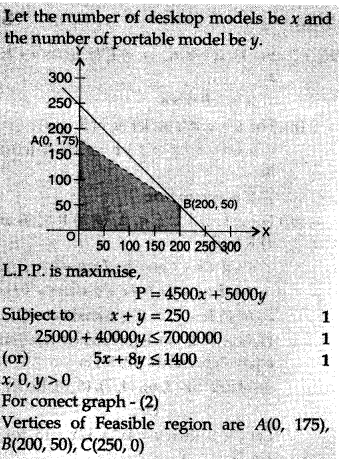
25.A merchant plans to sell two types of personal computer : a desktop model and a portable model that will cost Rs 25,000 and Rs 40,000 respectively. He estimates that the total monthly demand of computers will not exceed 250 units. Determine the number of units of each type of computers which the merchant should stock to get a maximum profit, if the does not want to invest more than 70 lakh and if his profit on the desktop model is Rs 4,500 and that on portable is Rs 5,000.
Ans.
CBSE Sample Papers for Class 12 Maths Solved 2016 Set 2-31
CBSE Sample Papers for Class 12 Maths Solved 2016 Set 2-32

26.A jet of enemy is flying along the curve y = x2 + 2 and a soldier is placed at the point (3, 2). Find the minimum distance between the soldier and the jet.
Ans.
CBSE Sample Papers for Class 12 Maths Solved 2016 Set 2-33

CBSE Sample Papers for Class 12 Maths 2016 Set 1

0

SECTION — A

Question numbers 1 to 6 carry 1 mark each
CBSE Sample Papers for Class 12 Maths Solved 2016 Set 1-1
CBSE Sample Papers for Class 12 Maths Solved 2016 Set 1-2
CBSE Sample Papers for Class 12 Maths Solved 2016 Set 1-3
CBSE Sample Papers for Class 12 Maths Solved 2016 Set 1-4
CBSE Sample Papers for Class 12 Maths Solved 2016 Set 1-5
CBSE Sample Papers for Class 12 Maths Solved 2016 Set 1-6
CBSE Sample Papers for Class 12 Maths Solved 2016 Set 1-7
CBSE Sample Papers for Class 12 Maths Solved 2016 Set 1-8
CBSE Sample Papers for Class 12 Maths Solved 2016 Set 1-9
CBSE Sample Papers for Class 12 Maths Solved 2016 Set 1-10

SECTION — B

Question numbers 11 to 22 carry 4 marks each
CBSE Sample Papers for Class 12 Maths Solved 2016 Set 1-11
CBSE Sample Papers for Class 12 Maths Solved 2016 Set 1-12
CBSE Sample Papers for Class 12 Maths Solved 2016 Set 1-13
CBSE Sample Papers for Class 12 Maths Solved 2016 Set 1-14
CBSE Sample Papers for Class 12 Maths Solved 2016 Set 1-15
CBSE Sample Papers for Class 12 Maths Solved 2016 Set 1-16
CBSE Sample Papers for Class 12 Maths Solved 2016 Set 1-17
18.An experiment succeeds thrice as often as it fails. Find the probability that in the next five trials, there will be at least 3 successes.
CBSE Sample Papers for Class 12 Maths Solved 2016 Set 1-18
CBSE Sample Papers for Class 12 Maths Solved 2016 Set 1-19
CBSE Sample Papers for Class 12 Maths Solved 2016 Set 1-20
CBSE Sample Papers for Class 12 Maths Solved 2016 Set 1-21

SECTION — C

Question numbers 23 to 29 carry 6 marks each.
23.A manufacturing company makes two types of teaching aids A and B of Mathematics for class XII. Each type of A requires 9 labour hours of fabricating and 1 labour hour for finishing. Each type of B re­quires 12 labour hours for fabricating and 3 labour hours for finishing. For fabricating and finishing, the maximum labour hours available per week are 180 and 30 respectively. The company makes a profit of Rs 80 on each piece of type A and Rs 120 on each piece of type B. How many pieces of type A and type B should be manufac­tured per week to get a maximum profit ? Make it as an LPP and solve graphically. What is the maximum profit per week ?

24.There are three coins. One is a two-headed coin (having head on both faces), another is a biased coin that comes up heads 75% of the times and third is also a biased coin that comes up tails 40% of the times. One of the three coins is chosen at random and tossed, and it shows heads. What is the probability that it was the two-headed coin ?
OR
Two numbers are selected at random (without replacement) from the first six positive integers. Let X denote the larger of the two numbers obtained. Find the probability distribution of the random variable X, and hence find the mean of the distribution.

CBSE Sample Papers for Class 12 Maths Solved 2016 Set 1-22

26.Two schools A and B want to award their selected students on the values of sincerity, truthfulness and helpfulness. The school A wants to award Rs x each, Rs y each and Rs z each for the three respective values to 3,2 and 1 students respectively with a total award money of Rs 1,600. School B wants to spend Rs 2,300 to award its 4,1 and 3 students on the respective values (by giving the same award money to the three values as before). If the total amount of award for one prize on each value is Rs 900, using matrices, find the award money for each value. Apart from these three values, suggest one more value which should be considered for award.

27.Using integration, find the area of the region bounded by the triangle whose vertices are (-1,2), (1,5) and (3,4).

CBSE Sample Papers for Class 12 Maths Solved 2016 Set 1-23

CBSE Sample Papers for Class 12 Maths Solved 2016 Set 1-24

Sociology Class XII NCERT Text Book PDF Download

0

Class XII NCERT Text Book Of Sociology Part 1

[gview file=”https://www.flexiprep.com/d/pdf/eed0b676/NCERT-Class-12-Sociology-Part-1.pdf”]

Class XII NCERT Text Book Of Sociology Part 1 In Hindi

[gview file=”https://www.flexiprep.com/d/pdf/7f823457/NCERT-Hindi-Class-12-Sociology-Part-1.pdf”]

Class XII NCERT Text Book Of Sociology Part 2

[gview file=”https://www.flexiprep.com/d/pdf/822a155f/NCERT-Class-12-Sociology-Part-2.pdf”]

Class XII NCERT Text Book Of Sociology Part 2 in Hindi

[gview file=”https://www.flexiprep.com/d/pdf/96b9544/NCERT-Hindi-Class-12-Sociology-Part-2.pdf”]

Sociology Class XI NCERT Text Book PDF Download

0

Class XI NCERT Text Book Of Sociology Part 1

[gview file=”https://www.flexiprep.com/d/pdf/bc6ca437/NCERT-Class-11-Sociology-Part-1.pdf”]

Class XI NCERT Text Book Of Sociology Part 1 In Hindi

[gview file=”https://www.flexiprep.com/d/pdf/52611284/NCERT-Hindi-Class-11-Sociology-Part-1.pdf”]

Class XI NCERT Text Book Of Sociology Part 2

[gview file=”https://www.flexiprep.com/d/pdf/47f7b4f6/NCERT-Class-11-Sociology-Part-2.pdf” save=”1″]

Class XI NCERT Text Book Of Sociology Part 2 In Hindi

[gview file=”https://www.flexiprep.com/d/pdf/8b552b47/NCERT-Hindi-Class-11-Sociology-Part-2.pdf” save=”1″]

Psychology Class XII NCERT Text Book PDF Download

0

Class XII NCERT Text Book Of Psychology

[gview file=”https://www.flexiprep.com/d/pdf/1544fe5b/NCERT-Class-12-Psychology.pdf”]

Class XII NCERT Text Book Of Psychology  In Hindi

[gview file=”https://www.flexiprep.com/d/pdf/25ae5604/NCERT-Hindi-Class-12-Psychology.pdf”]

Psychology Class XI NCERT Text Book PDF Download

0

Class XI NCERT Text Book Of Psychology

[gview file=”https://www.flexiprep.com/d/pdf/47ce83f7/NCERT-Class-11-Psychology.pdf”]

Class XI NCERT Text Book Of Psychology In Hindi

[gview file=”https://www.flexiprep.com/d/pdf/c639978f/NCERT-Hindi-Class-11-Psychology.pdf”]

Political Science Class XII NCERT Text Book PDF Download

Class XII NCERT Text Book Of Political Science Part 1

[gview file=”https://www.flexiprep.com/d/pdf/9c64c1c7/NCERT-Class-12-Political-Science-Part-1.pdf”]

Part 2

[gview file=”https://www.flexiprep.com/d/pdf/1ac095fb/NCERT-Class-12-Political-Science-Part-2.pdf”]

In Hindi

[gview file=”https://www.flexiprep.com/d/pdf/f629f09b/NCERT-Hindi-Class-12-Political-Science.pdf”]


Political Science Class XI NCERT Text Book PDF Download

Class XI NCERT Text Book Of Political Science Part 1

[gview file=”https://www.flexiprep.com/d/pdf/53056d74/NCERT-Class-11-Political-Science-Part-1.pdf”]

[Responsive_Ads][/Responsive_Ads]

Class XI NCERT Text Book Of Political Science Part 1 in Hindi

[gview file=”https://www.flexiprep.com/d/pdf/2a0716a5/NCERT-Hindi-Class-11-Political-Science-Part-1.pdf”]

Class XI NCERT Text Book Of Political Science Part 2

[gview file=”https://www.flexiprep.com/d/pdf/946a9418/NCERT-Class-11-Political-Science-Part-2.pdf”]

[Responsive_Ads][/Responsive_Ads]

Class XI NCERT Text Book Of Political Science Part 2 in Hindi

[gview file=”https://www.flexiprep.com/d/pdf/23df8191/NCERT-Hindi-Class-11-Political-Science-Part-2.pdf”]

Science Class 9 Chapter – 8 : Motion | Notes | Study material and PDF download

2

Science for Class – IX (NCERT)

Chapter 8 – Motion

8.1- Introduction

Motion, as the word itself says, is the movement of different living and non-living things. We see birds flying, people moving, cars running – all of which are different types of motions that we come across in our everyday life. What can we study about motion? Why is the study of motion included in the study of physics? Let us go through this chapter to understand this.

8.2 – How do we describe motion?

How do we know that something is in motion or not? Before we discuss this topic furthermore, let us talk about two familiar terms that are necessary to know about in this chapter

Motion: The state in which an object (or person) is moving is called the state of motion.

Rest: The state in which an object (or person) is not moving is called the state of rest. So, for an object that is simply lying on the ground, we say that the object is in a state of rest.

Now coming back to the topic, how can we know that an object is moving? Or how can we say that and object is in the state of rest? If we find that the distance of an object from a fixed point is continuously increasing or decreasing, then we might say that the object is moving or the object is in the state of motion. The fixed point about which we are talking is also called the reference point or origin.

Origin: The origin is a reference point which is used to determine the state and location of an object. An object can be near, far, beside, below or above that reference point (or origin).

8.2.1- Motion along a straight line

To understand above points more clearly, we must learn about motion along a straight line. It is the simplest type of motion. To understand this concept more clearly, take the example of an object moving along a straight path.

Suppose, the object starts its journey from O, which is treated as its reference point or origin. Then A, B and C represent the position of that object at different intervals. Now, first the object moves towards A, passing the points C and B in its way. Then, it moves back along the same path and reaches at C passing through B.

Let us calculate the length that it has covered. It is OA + AC, i.e. 60 km + 35 km = 95 km. Here, in this case, we need to specify only the numerical value of the distance covered by the object in order to calculate it; we don’t need to specify the direction of motion. Many quantities are described by only their numerical value.

The numerical value of a physical quantity is also called its magnitude. Also, there are some terms that may appear many times in this and the next chapter:

Distance: The magnitude of length covered by an object is known as distance.

Initial position: Position of an object when it is at the origin or the position of an object before it has started to move is called its initial position. The word ‘initial’ means starting. So, initial position is the starting position of an object.

Final position: The position of an object after it has completed its movement/completed moving is called its final position. It is the position at which the object has stopped.

Displacement: It is the shortest distance between the initial position and the final position of an object. In this case, the displacement of the object is the distance between O and C i.e. 25 km.

Can the distance and displacement be equal?

The topic that we are going to discuss now is not about finding any relation between the distance and the displacement, but it focuses on the difference between the distance and the displacement.

Suppose, the object moves again from O to B. This time the distance is 35 km and the displacement is also 35 km. In such a simple case, the distance and displacement can be equal. Now, suppose the object moves from B to C. The distance in this case is 35 + 10 km (since B and C are at a distance of 10 km from each other)=45 km while the displacement would be 25 km which is the shortest distance between O and C. Also, suppose that the object returns back to O. The distance now would be 45 + 25 = 70 km. What is the displacement now?

We see that the initial position and the final position of the object are the same i.e. O. So, the displacement now would be zero. So, again the distance and displacement are not equal in this case. Thus we conclude that distance and displacement are two different quantities that are used to determine the overall motion of an object. We also conclude that the displacement can be zero in case the initial position and final position of an object coincide with each other (are at the same point).

8.2.2 – Uniform and Non-uniform motion

In this section, we discuss two categories of motion which are related to its speed, i.e. distance covered in unit time. Let us look at these terms:

Uniform motion: When an object covers equal amounts of distance in equal intervals of time, then it is called the uniform motion. For instance, suppose a man who is walking is able to walk 100 metres in one minute, another 100 metres in second minute and another 100 metres in the third minute, then it is the uniform motion.

Non-uniform motion: When an object covers unequal amounts of distance in equal intervals of time, it is called non-uniform type of motion. For instance, suppose when a car covers a distance of 30 km in one hour, 35 km in second hour and 32 km in third hour, then it is called the non-uniform motion.

8.3- Speed/Rate of motion

We know that different objects may take different amount of time in covering different amount of distance. Some may be slow and some may be fast. This rate at which an object covers the given distance is called its speed.

Also, we must introduce a familiar term, called the SI unit. Many of you may know about this term, but for those who don’t know, SI unit is a unit in which a given quantity can be expressed. To understand this more clearly, look at the table of SI units of familiar quantities that is given below:

We see that distance is usually expressed in metres, so its SI unit is ‘Metre’ or ‘m’ in short. Again, the displacement is nothing but another type of distance, so its SI unit is again ‘Metre’ or ‘m’. In the case of time, its basic unit is second so its SI unit is also ‘Second’ or ‘s’ in short.

Now, speed is also a quantity. So, there is an SI unit of speed too. The SI unit of speed is metre per second or m/s. This is also referred as m s-1. There are some other units of speed like centimetre per second (cm s-1), and kilometre per hour (km h-1). These are not the SI units but these units are commonly used while specifying the speed of an object.

Average speed: The total amount of distance travelled by an object in the total amount of time is known as the average speed of that object. We use average speed because speed of most objects is non-uniform and keeps changing.

Average speed =

                                    Total distance travelled / Total time taken

So, if an object travels a distance s in time t, the speed v is,

                                              v=s/t

For example, suppose a car travels a distance of 120 km in 3 hrs, then its average speed v is 120/3 = 40 km/h. The car might not have travelled at 40 km/h at all the time and sometimes it may have been faster or slower, but this is the average speed of the car.

8.3.1- Speed with direction

When we specify the direction of motion along with its speed, we are referring to its velocity. Velocity is the speed of an object moving in a specific/definite direction. The velocity of an object can be either uniform or variable. The velocity can be changed by changing object’s speed, changing object’s direction of motion or changing both speed and direction of motion.

Average velocity:

If an object is moving along a straight path, we can express the magnitude of its rate of motion in terms of its average velocity.

Suppose the velocity of an object is changing at a uniform rate, then the average velocity can be given by finding the arithmetic mean of the initial velocity and the final velocity for a given period of time.

Average velocity =

                              (Initial velocity + Final velocity)/2

Mathematically, vav =

                                   (u + v)/2

Where vav is the average velocity, u is the initial velocity and v is the final velocity of the object. SI unit of velocity is the same as that of speed i.e. m/s or m s-1.

For example, suppose the initial velocity of an object is 200 km/h and final velocity is 250 km/h then the average velocity is 200 + 250/2 = 450/2 which is equal to 225 km/h.

8.4- Acceleration

As we have discussed earlier, the velocity of an object does not remain the same all time but keeps changing, i.e. the velocity is not uniform all the time. In case of uniform velocity, there is no change in the velocity, which means that the change in the velocity of the object is ‘zero’. In case of non-uniform motion, velocity keeps changing with time. It has different values at different intervals of time. So, in case of non-uniform motion, the change in velocity is not zero.

Acceleration:

There is another quantity called acceleration, which is used to measure the rate of change of velocity of an object per unit time. We can define acceleration as:

Acceleration =

                           Change in velocity/Time taken


Now, suppose the velocity of an object changes from initial velocity u to the final velocity v in the time t, the acceleration a is:

                             a =                               (v-u)/t


Accelerated motion: Motion in which the velocity of an object keeps changing or is non- uniform is called the accelerated motion.

If the acceleration is in the direction of the velocity, then it is taken as positive. If the acceleration is in the opposite direction of velocity, then it is taken to be negative. The SI unit of acceleration is m/s2 or m s-2. There are two types of acceleration:

  1. Uniform acceleration: If an object travels in a straight line and its velocity increases or decreases by equal amounts in equal intervals of time, then it is the uniform acceleration. Take the example of a freely falling object, which is moving in uniform acceleration.
  2. Non-uniform motion: If the velocity of an object increases or decreases by unequal amounts in equal intervals of time, then it is the non-uniform motion. Take the example of a car moving along a straight road increasing its speed by unequal amounts in equal intervals of time, then the car is moving with non-uniform acceleration.

8.5- Graphical Representation of Motion

Now, when we have talked about various concepts regarding motion, we must also discuss about representing motion with the help of graphs. Graphs make it easy to present basic information and one can learn more easily with the help of graphs. So, to describe the motion of an object, we can use line graphs. These graphs are discussed below:

8.5.1- Distance-Time Graphs

Distance – Time graphs can be used to represent the change position of an object with time by using a convenient scale of your choice. In such graphs, time is taken along the x-axis and distance is taken along the y-axis. Distance time graphs can be used to show conditions of uniform motion, non-uniform motion, or when the object is at rest, etc.

Graph for uniform speed-

When an object travels equal distance in equal intervals of time, it is moving with a uniform speed. In such case the distance travelled by the object is directly proportional to the time taken. Thus for uniform speed, the distance-time graph would be a straight line.

The distance-time graph can be used to determine the speed of an object. We just need to measure the distance between two points on the given line using the y-axis and measure the time using x-axis. Then the speed v is equal to,

                 v =                                   (s2-s1) / (t2-t1)


                                               Image source: Google images


Graph for non-uniform speed-

The distance-time graph for non-uniform speed is different from that of uniform motion as it is in the form of a curve. This graph shows the non-linear variation of the distance travelled by an object with time.

                                               Image source: Google images

8.5.2- Velocity-Time Graphs

In velocity-time graphs, the time is taken along the x-axis and the velocity is taken along the y-axis. Now, let us discuss about velocity-time graphs for uniform and non-uniform velocity:

Graph for uniform velocity-

In case of uniform velocity, the height of the velocity-time graph will not change with time. It will be a straight line parallel to the x-axis.

     Image source: Google images

The product of the velocity and time gives the displacement of an object which is moving with a uniform velocity. So, in our graph, the area enclosed by the velocity-time graph and the time axis will be equal to the magnitude of displacement. In above graph, the distance moved by the object in time (t2-t­1) is equal to AC ×CD;

= [(40 km/h) × (t2-t1) h]

= 40 (t2-t1) km

= area of rectangle ABCD which is shaded in blue colour

Graph for uniformly accelerated motion-

Before moving to non-uniform motion, it is important to discuss about the velocity-time graph for a uniformly accelerated motion of an object. In such cases, for example when a car is moving with uniformly accelerated velocity, the velocity changes by equal amounts in equal intervals of time. So, in every case of uniformly accelerated motion, the velocity-time graph is a straight line.

In the following graph, we can determine the distance travelled by the object by calculating the area of figure ABCDE under the velocity-time graph that is given below.

i.e. the distance, s = area ABCDE

= area of rectangle ABCD + area of triangle ADE

                                               Image source: Google images

= [AB × BC] + [½(AD × DE)]

Graph for non-uniform velocity-

For non-uniform velocity, there is not much thing to look at except to see how these graphs do look. There are two types of such graphs available:

  1. Motion of an object whose velocity is decreasing with time

                                               Image source: Google images

As you can see, there is not much thing to discuss about this graph as this graph is self-explanatory.

2. Non-uniform variation of velocity of an object with time

                                                 Image source: Google images

However, in the above graph you can see that the non-uniform motion has been represented by zigzag lines which is divided into several parts. You can easily find out the magnitude of distance by calculating Area of ( triangle AOG + rectangle ABFG + trapezium BCEF + triangle CDE ).

8.6 – Equations of Motion using the Graphical Method

When an object is moving along a straight line with uniform acceleration, then its velocity, acceleration during the motion and the distance covered by it in a certain time interval can be related with the help of certain equations which are known as the equations of motion. These equations are:

                                       v = u + at         —- (i)

                                  s = ut + ½ at2           —- (ii)

                             2 a s = v2 – u2                —- (iii)

where,

       u – initial velocity                                     v – final velocity

       a – uniform acceleration                           s – distance travelled

       t – time taken

These three equations can be represented using the graph which is given below:

                                               Image source: Google images

8.6.1- Equation for Velocity-Time Relation

In the graph given above, consider a body moving with a uniform acceleration a, with the initial velocity u and the final velocity v in the time t. The perpendicular lines BC and BE are drawn from B to x-axis and y-axis. The initial velocity is OA and final velocity is BC. Also, the time taken is OC. AD || OC.

Now,

BC = BD + DC

= BD + OA

Substituting BC = v and OA = u,

v = BD + u

Or,                                        BD = vu

Acceleration =                 Change in velocity/Time

a =      BD/AD   = BD/OC

Or, a = (v – u)/t

v – u = at

Or, v = u + at

8.6.2- Equation for Position-Time Relation

Now, again in the same graph we can take the distance s as:

s = area of OABC (which is a trapezium)

= OA × OC + ½ (AD × BD)

Now, substituting OA = u, OC = AO = t

BD = v – u = at

                             s = u × t + 1/2 (AD × BD)

                             s = ut + ½ (t × at)

                       or, s = ut + ½ at2

8.6.3- Equation for Position-Velocity Relation

Again in the same graph, we have,

s = area of trapezium OABC

= (OA +BC) × OC/2

Substituting OA = u, BC = v and OC = t,

s = (u+v) t/2

From velocity-time relation,

t = (v-u)/a

   s = (v+u) × (v-u)/2a

Or,      2as = v2– u2

8.7- Uniform Circular Motion

Now we have come to the last topic of our first physics chapter of class 9th i.e. uniform circular motion. Since there are a lot of questions asked about this topic in exams, we must discuss this whole chapter little by little breaking it into various subtopics. Let us first start with the definition of this term itself:

Uniform Circular Motion:

The motion in a circular path with uniform speed is known as uniform circular motion. Thus, an object moving in a circular path with uniform speed is said to be moving in uniform circular motion.

Now let us move to further discussions:

Changing of directions during circular motion:

Suppose an object moves on a rectangular path, then the object has to change its direction four times before it completes its path. Similarly, in a hexagon, it will change its direction six times and in a octagon, it will change its direction eight times. If we go on increasing the number of sides indefinitely, the shape of the path would slowly approach the shape of a circle and the length of the sides would be decreased into a point. Also, an object that is moving along a circular path would change its direction an indefinite number of times as the number of sides is increased by an indefinite number.

Change of velocity during circular motion:

When an object moves along a circular path, the only change in its velocity is due to the change in the direction of motion. Thus, the motion of an object moving along a circular path is also an example of accelerated motion.

Calculating the velocity during motion on a circular path:

Suppose the radius of the circular path is r, then its circumference is given by 2πr. If an object takes t seconds to go once around the circular path, the velocity v is given by

v =           2πr/2                                  

Example of uniform circular motion:

If you take a piece of thread and tie a small piece of stone at one of its ends, then hold the other end of the thread in one hand and move the thread in a circular motion, it will be an example of an object moving in uniform circular motion. If, at any instance, you release the thread from your hand, the thread would move in a straight line which shows that the direction of motion changed at every point when the stone was moving along the circular path.

Other examples of uniform circular motion are the movement of moon and the earth, a satellite in a circular orbit around the earth, a cyclist on a circular track at constant speed and an athlete rotating his body before throwing a hammer or discuss.

So, here our first physics chapter of Motion for class 9th comes to an end. We have discussed all important topics and you need to be clear in all these topics because these are simply the basic topics and would be useful in higher studies as the higher studies are all based on these small topics that you learn in the small classes. If you have any other doubt, leave a comment or contact us using our e-mails provided in our site or go to hello@imperialstudy.com .